
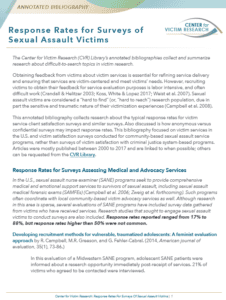
Obtaining feedback from victims about victim services is essential for refining service delivery and ensuring that services are victim-centered and meet victims’ needs. However, recruiting victims to obtain their feedback for service evaluation purposes is labor-intensive, and often difficult work (Crandall & Helitzer 2003; Koss, White & Lopez 2017; Weist et al. 2007). Sexual assault victims are considered a “hard to find” (or, “hard to reach”) research population, due in part the sensitive and traumatic nature of their victimization experiences (Campbell et al 2008).
This annotated bibliography collects research about the typical response rates for victim service client satisfaction surveys and similar surveys. Also discussed is how anonymous versus confidential surveys may impact response rates. This bibliography focused on evaluations of community-based victim services in the United States. Articles were mostly published between 2000 to 2017. Contact the CVR Research Librarian for assistance locating additional articles and for accessing full-text.
CVR staff thank principal authors Sara Bastomski, PhD, & Janine Zweig, PhD, for their work developing this annotated bibliography.
Download
For the complete report with article links, download the full annotated bibliography:
See more CVR Annotated Bibliographies.

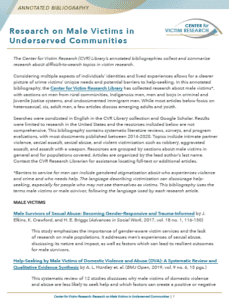
Considering multiple aspects of individuals’ identities and lived experiences allows for a clearer picture of crime victims’ unique needs and potential barriers to help-seeking. In this annotated bibliography, the Center for Victim Research Library collected research about male victims*, with sections on men from rural communities, Indigenous men, men and boys in criminal and juvenile justice systems, and undocumented immigrant men. While most articles in this bibliography focus on heterosexual, cis, adult men, a few articles discuss emerging adults and youth.
*Barriers to service for men can include gendered stigmatization about who experiences violence and crime and who needs help. The language describing victimization can discourage help seeking, especially for people who may not see themselves as victims. This bibliography uses the terms male victims or male survivor, following the language used by each research article.
Methods
Searches were conducted in English in the CVR Library collection and Google Scholar. Results were limited to research in the United States and the bibliography is a not a comprehensive literature review. This bibliography contains systematic literature reviews, surveys, and program evaluations, with most documents published between 2014-2020. Topics include intimate partner violence, sexual assault, sexual abuse, and violent victimization such as robbery, aggravated assault, and assault with a weapon. Resources are grouped by sections about male victims in general and for populations covered. Articles are organized by the lead author’s last name. Contact the CVR Research Librarian for assistance locating additional articles.
Search Tips
• Male: men, boys, masculinity
• Crime: victimization, harm, violence, abuse, trauma, assault
View an example search in the CVR Library.
Download
For the complete report with article links, download the full annotated bibliography:
See more CVR Annotated Bibliographies.

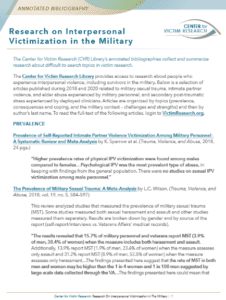
The Center for Victim Research Library provides access to research about people who experience interpersonal violence, including survivors in the military.
Methods
Searches were conducted in English in the CVR Library collection and limited to articles published during 2018 and 2020. Topics include military sexual trauma, intimate partner violence, and elder abuse experienced by military personnel, and secondary post-traumatic stress experienced by deployed clinicians. Articles are organized by topics (prevalence, consequences and coping, and the military context – challenges and strengths) and then by author’s last name. Contact the CVR Research Librarian for assistance locating full text or additional articles.
Search Tips
Below are similar or related keywords for:
- Military: Air Force, Navy, Army, Marines, Special Forces, deployment, combat
- Servicemembers: Veterans, soldiers, troops
- Victimization: violence, assault, harassment, abuse, crime, military sexual trauma, hazing
View an example search in the CVR Library.
Download
For the complete report with article links, download the full annotated bibliography:
See more CVR Annotated Bibliographies.

Restorative justice practices offer an addition, or in some cases an alternative, to the traditional retributive justice system. Rather than focusing on punishment, restorative justice focuses on repairing the harm by engaging victims, offenders and their families, other citizens, and/or community groups in the process. Victims who participate in restorative justice typically express higher levels of satisfaction than those whose cases are handled in the traditional justice system. This annotated bibliography gathers research on the impact of restorative justice practices on victims, among other outcomes.
Methods
Searches were conducted in English in the CVR Library collection, Google Scholar, and the National Criminal Justice Reference Service. Most papers were published between 2009 and 2019, and this bibliography includes meta-analyses, journal articles, and program evaluations. Articles are sorted first by year and then by author. The research articles in this bibliography focus primarily on victim-offender mediation, victim-offender dialogue, and restorative justice conferencing. Contact the CVR Research Librarian for assistance locating full text or additional articles.
CVR staff thank Bailey Maryfield for her work compiling and summarizing the research in this bibliography.
Search Tips
Below are similar or related keywords for:
- Restorative Justice: victim-offender mediation, victim-offender dialogue, restorative justice conferencing, family group conferencing, community reparative boards, reparative boards, victim impact panels, victim impact training, peacemaking circles, circle sentencing, apology banks
- Recidivism: reoffending, repeat offending, rearrest, reconviction, recidivist, subsequent delinquent behavior
- Victim Outcomes: satisfaction with the process, material restoration, emotional restoration
View an example of how to combine search terms to create a database search string.
Download
For the complete report with article links, download the full annotated bibliography:

See more CVR Annotated Bibliographies.
August 2020 Virtual Journal Club Session

Welcome to the Center for Victim Research Virtual Journal Club for August 2020. (Learn more about the journal club and sign up to join us!)
Article
For this session, our theme is Well-being for Victim Services Staff. We read:
‘The Only Way We’ll Be Successful’: Organizational Factors That Influence Psychosocial Well-Being and Self-Care Among Advocates Working to Address Gender-Based Violence by E. Çayir, M. Spencer, D. Billings, D.K. Hilfinger Messias, A. Robillard, & T. Cunningham. Journal of Interpersonal Violence, 2020. (Abstract)
- Full-text will also be sent a week before the journal club session to those who signed up.
- Let us know if you have issues accessing the article or logging into VictimResearch.org
Quick Tips on Reading Research Articles
- The CVR glossary can be a good starting place for definitions of research words frequently used in victim research.
- Review additional tips in our Quick Reference: Tips on Reading Research Articles.
Twitter Chat
We hosted a Twitter chat with one of the article authors, Dr. Ebru Çayir, on Wednesday August 5, 2-3pm EST. Dr. Çayir is a postdoctoral research associate with the Compassionate Care Initiative (CCI) at the University of Virginia, School of Nursing. Her research focuses on promoting mental health, well-being and resilience among caregiving professionals by adopting collective, diverse and inclusive approaches. More details on the CCI website. Review tips for participation and questions we posted: August Twitter Chat Guide & Questions Preview.
#CVRchat Moment on Victim Advocate Well-being
Discussion
Below are discussion prompts for journal club members to think about and comment on. There are multiple ways to participate in discussion during August 3-7, 2020:
- Login to VictimResearch.org and return to this post to add your comments below. (Detailed instructions: How to Comment)
- Reply to our Twitter, Facebook, and LinkedIn #JournalClub posts about these questions.
Discussion Prompts
- What are common misconceptions you’ve heard when defining self-care? Did reading the article shift your perspective about psychosocial well-being & self-care in the workplace?
- This study used Constructivist Grounded Theory. The researchers did not start with a preconceived hypothesis, but allowed themes to emerge based on participants’ views, and acknowledged multiple possible interpretations of the data. What do you think about this approach for capturing advocates’ viewpoints? What about this method did or did not work well?
- The authors note “Due to the sensitive nature of the issues we examined…it is possible that advocates who felt comfortable about commenting on these issues self-selected into the study.” What might be some additional ways to capture the perspectives of more advocates in research?
- One study participant discussed concerns about hiring staff based more on their degrees than on their “fit” in nonprofit environments that value employees’ well-being. What are benefits and challenges in the “professionalization” of victim services and in applying a business model to a human services organization?
- The researchers discussed how “close-knit” organizational culture may provide advocates with social support systems; however, such structures can also risk violating personal boundaries. What efforts can victim services organizations make to build teamwork, while protecting staff members’ personal boundaries?
- The study participants emphasized the need for open door policies, avenues for confidential feedback, and staff involvement in decision-making. How can organizations improve their responses to difficult feedback?
- The researchers stress the critical need of organizations to support psychosocial well-being and self-care. What are your thoughts on study participants’ suggestions for institutional changes (flexible work schedules/locations, more vacation time, access to mental health services, collective efforts to improve health, debriefing sessions, and retreats) to support staff well-being? What challenges could prevent these changes from being implemented?
June 2020 Virtual Journal Club Session

Welcome to the Center for Victim Research Virtual Journal Club for June 2020. (Learn more about the journal club and sign up to join us!)
Article
For this session, our theme is Victims’ Experiences of Research Participation. We read:
- Predicting the Effects of Sexual Assault Research Participation: Reactions, Perceived Insight, and Help-Seeking by A. Kirkner, M. Relyea, & S.E. Ullman. Journal of Interpersonal Violence, 2019, vol. 34 no. 17, 3592. (Abstract)
- Login to VictimResearch.org and search the CVR Library for “predicting the effects of sexual assault research participation” to find the full-text article.
- Full-text will also be sent a week before the journal club session to those who signed up.
Let us know if you have issues accessing the article or logging in.
Quick Tips on Reading Research Articles
- The CVR glossary can be a good starting place for definitions of research words frequently used in victim research.
- Review additional tips in our Quick Reference: Tips on Reading Research Articles.
Discussion
There will be multiple ways to participate in discussion during June 22-26, 2020.
- Comment on VictimResearch.org: Login to VictimResearch.org and return to this post to add your comments below. Detailed instructions: How to Comment
OR
Twitter Chat
We hosted a Twitter chat with one of the article authors, Dr. Anne Kirkner, on Wednesday June 24, 2-3pm EST. Dr. Kirkner is a Criminologist for the Illinois Criminal Justice Information Authority and manages their Center for Victim Studies. Discover more of Dr. Kirkner’s research through her Research Gate profile.
Discussion Prompts
Respond to any or all of the following prompts and add any other reactions you had while reading this article. Throughout the week, come back to read and respond others’ comments.
- Did reading the article “Predicting the Effects of Sexual Assault Research Participation” shift your perspective about involving crime victims in research?
- The researchers noted the importance of using non-blaming survey language and providing participants with a list of community resources. Especially when research is not conducted in-person, what else can researchers do to ensure their research process is trauma-informed and victim-centered?
- The researchers discussed study findings that surprised them, like the relationship between emotional dysregulation and increased insights from research participation. What did you think of the researchers’ idea that “those who have trouble inhibiting distressing emotions during the survey may have more opportunities for thinking about and possibly gaining insight into what upsets them”?
- While this study found that most survivors had a positive reaction to participating in the survey, what barriers may prevent crime victims or victim services organizations from participating in research?
- The article mentions how these findings could apply to IRB applications and college surveys about traumatic experiences. How might the article’s findings impact victim assistance screening and assessment or programs?
- Has your organization participated in research on victim services and victimization? How did you work with researchers to build in protections for study participants’ safety and privacy?
CVR Virtual Journal Club

You’re invited to the Center for Victim Research Virtual Journal Club! Every other month, service providers and researchers will read and discuss online a research article about victim services and crime victims.
Benefits: access subscription articles through the CVR Library, learn about research findings, network with other practitioners across the U.S., and add your perspective about the emerging evidence base for victim services.
Join the CVR Virtual Journal Club
Schedule:
April 27-May 1, 2020: Cybervictimization and Virtual Victim Services
- Digital poly-victimization: The increasing importance of online crime and harassment to the burden of victimization by S. Hamby, Z. Blount, A. Smith, L. Jones, K. Mitchell, & E. Taylor. Journal of Trauma & Dissociation, 2018, vol. 19 no. 3, 382-398. (Abstract)
June 22-26, 2020: Victims’ Experiences of Research Participation
- Predicting the Effects of Sexual Assault Research Participation: Reactions, Perceived Insight, and Help-Seeking by A. Kirkner, M. Relyea, & S.E. Ullman. Journal of Interpersonal Violence, 2019, vol. 34 no. 17, 3592. (Abstract)
August 3-7, 2020: Well-being for Victim Services Staff
- ‘The Only Way We’ll Be Successful’: Organizational Factors That Influence Psychosocial Well-Being and Self-Care Among Advocates Working to Address Gender-Based Violence by E. Çayir, M. Spencer, D. Billings, D.K. Hilfinger Messias, A. Robillard, & T. Cunningham. Journal of Interpersonal Violence, 2020. (Abstract)
How does it work?
- Sign up by clicking Join the CVR Virtual Journal Club: enter your email address, check the box “Subscribe me to the CVR journal club,” and click Submit.
- Receive the article and reading tips in your inbox (check your spam just in case).
- Read the article and take notes.
- Login to VictimResearch.org to make sure you’re ready to comment; you may need to reset your password if you haven’t logged in for a long time. (Never logged in? Register here.)
During the week of that month’s journal club:
- Receive details about the discussion board and Twitter chat in your inbox.
- Login to VictimResearch.org to respond to discussion prompts about the article and share your thoughts and questions with other participants.
- Interact with an article author during a Twitter chat. Don’t have a Twitter account? Follow the conversation with the #CVRchat hashtag and email questions or comments ahead of the chat to librarian@victimresearch.org.
Tips
Unsure if reading research is for you, or how to get started? In addition to facilitating discussion, CVR will provide guides on frequently used research lingo and tips on reading a research article.
- Quick Reference: Tips for Reading Research Articles
- CVR Glossary
Newsletters For Timely Victim Research

Newsletters can deliver timely articles from a broad range of sources and provide unique commentary on issues relevant to victim services professionals. Newsletters can help you stay in the loop on the latest studies and research trends and on the evolving conversations and thoughts of your colleagues. Below are newsletters that frequently include victim research, including resources related to child abuse, elder abuse, sexual violence, gender-based violence, intimate partner violence, criminal justice, community engagement, and social and health services.
If you see an article mentioned in these newsletters, search the title in the CVR Library search box or email the CVR Research Librarian to request it.
Also, if you haven’t already, sign up for the Center for Victim Research’s monthly newsletter and be the first to know about our new webinars, podcasts, tools, and publications: Sign Up Here.
Newsletters Focused on Victim Services Professionals
- Information for Practice (IP): delivers links to social services research, including free reports from nonprofits and government agencies. Gary Holden of New York University – Silver School of Social Work compiles this monthly email with the titles and links to articles or their abstracts. Sign Up Here (send a blank email)
- Monday Missives (MM): Created by “Justice Sister” Anne Seymour, this newsletter includes a weekly roundup of news and investigations, research studies, webinars and conferences, and inquiries about best practices/”how do programs do this”, all related to crime victims, victim services, trauma, adverse childhood experiences, and resilience. Sign Up Here (send a blank email)
Newsletters Focused on Specific Populations
- CALiO Email List: Online since 2004, the Child Abuse Library Online provides access to over 3,000 free open access research articles related to child abuse, children’s advocacy centers, vicarious trauma, and other topics relevant to professionals working with victims of child abuse and their families. Keep up with new additions to the CALiO collection and monthly research quizzes by signing up for the National Children’s Advocacy Center‘s newsletter and selecting the CALiO Email List. Sign Up Here
- Esperanza United: This twice-monthly newsletter shares Esperanza United partner resources related to interpersonal violence, culturally relevant victim services, and survivors’ needs related to immigration and language access. Included are partner events and webinars, news, toolkits and research reports, book reviews (fiction and non-fiction), legislative actions, and job announcements. Sign Up Here
- NCEA Listserv: The National Center on Elder Abuse hosts regular Research2Practice webinars, where researchers present their recent study findings on elder abuse and neglect, financial crime targeting older adults, and Adult Protective Services and other relevant agencies. NCEA releases two-page briefs summarizing the findings from the research papers presented during webinars and creates fact sheets and research compilations. Learn about in-person and online trainings, read new reports and screening tools, and join the conversation on NCEA’s listserv. Sign Up Here
- NIWRC Mailing List: The National Indigenous Women’s Resource Center sends regular messages to its mailing list members, including webinar announcements, legislative updates, job openings, and report releases. Topics have included tribal participatory research methods, the availability of technical assistance, and improved data sharing with the national crime information databases. Sign Up Here
- Reaching Victims Newsletter: The National Resource for Reaching Victims produces a monthly newsletter with guest editors from their partner organizations. Each edition includes a quotation from a survivor or leader in the field, a summary of a grassroots organizations’ main activities, a spotlight on a promising practice, and list of upcoming events. Sign Up Here
Newsletters Focused on Criminal Justice
- CrimPapers: This email shares recent article titles drawn from 116 journals that often publish research in criminology, criminal justice, crime science, penology and terrorism. This alert is delivered daily or weekly. It was created by Matt Ashbury, a lecturer in criminology at Nottingham Trent University. Sign Up Here
- NCJRS Weekly Accessions: The National Criminal Justice Reference Service hosts a large library collection related to research in corrections, the justice system, law enforcement, crime, courts and victim rights, and results of evaluations and demonstration sites. This newsletter lists all the latest reports added to their collection. Sign Up Here
- NCVLI Update: The National Crime Victim Law Institute hosts a victim law library with materials organized by right, victim type, or procedural posture and includes case summaries related to victim rights. This newsletter announces new amicus briefs, summaries of recent technical assistance requests for legal research, and upcoming events. Sign Up Here
Newsletters focused on Domestic Abuse and Sexual and Gender-based Violence
- EVAWI Mailing List: End Violence Against Women International hosts regular trainings for criminal justice professionals and writes training briefs that summarize research and practice evidence related to sexual assault investigation practices. Their mailing list highlights innovative programs and webinar announcements and highlights from their resource library. Sign Up Here
- The Exchange: Carol E. Jordan, Executive Director of Office for Policy Studies on Violence Against Women at the University of Kentucky, compiles this monthly round-up of “research on intimate partner violence (IPV), child witnesses to IPV, sexual assault, stalking, and related crimes…to allow services; case decision-making; and criminal justice and health/mental health policy to be directly influenced by science.” Sign Up Here
- Forensic Healthcare Online: The founder and editor of Forensic Healthcare Online, Jenifer Markowitz, writes multiple short posts a week, suggesting news stories and research articles for forensic nurses and others working with sexual violence and trauma survivors. In addition to these short pieces, FHO also includes longer posts like clinical guides, testimony resources, training handouts, and tips on how to regular reading and applying research. Sign Up Here (scroll to website footer for sign up)
- NRCDV Newsletter: The National Resource Center on Domestic Violence sends a bi-monthly newsletter of new resources and developments. The newsletter often includes example technical assistance requests, questions of the month, and new resources available in VAWnet, their online library of thousands of materials related to addressing gender-based violence. Sign Up Here
- NSVRC Resource Round-up: The National Sexual Violence Resource Center delivers a monthly round-up of resources related to preventing sexual violence and working with survivors of sexual assault and harassment. The newsletter features guides, action kits, interviews with survivors and practitioners, infographics, new bibliographies from the NSVRC library, and fact sheets relevant to news stories about sexual violence. (Daily news updates are available through NSVRC’s Google Groups.) Sign Up Here
- SVRI Update: The Sexual Violence Research Initiative sends out weekly updates about their member events and a list of journal articles. The journal articles cover a range of topics and countries, all with some relation to violence against women, sexual violence, harassment, and assault. Sign Up Here

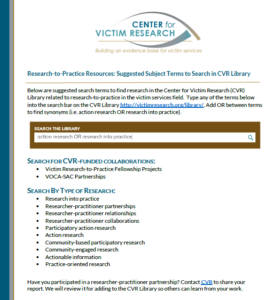
Victim researchers and practitioners working together can increase the understanding of crime victims’ needs and how programs can improve. Researcher-practitioner partnerships can create meaningful, practical research questions.
If you are not ready to start a collaboration with victim researchers, reading reports from existing collaborations can provide insight into how others approached their collaboration and the resources and time they needed for a successful collaboration. Also, these research-to-practice findings may still be useful for your own program, your outreach, your funding proposals.
Watch the tutorial below to learn how to find reports from researcher-practitioner collaborations in the Center for Victim Research Library:
Video
Tipsheet

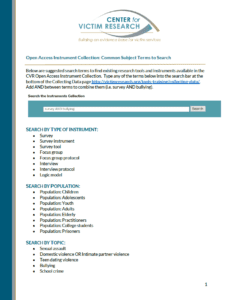
One of the goals of the Center for Victim Research (CVR) is to make resources related to victim services research and evaluation easier to find and use. As many victim service programs have already developed logic models and research instruments, CVR started a searchable collection of existing tools, which is available on the Collecting Data page.
By searching this collection, practitioners can locate free survey texts, focus group protocols, questionnaires, interview guides, and logic models. These tools are related to measuring victimization, crime reporting, victim needs, victim outcomes, victim satisfaction, and other topics. One special feature of the CVR instrument collection are the cover pages that accompany each tool, which describe the background and the intended purpose of the tool. These tools and their cover pages can help practitioners develop their own instruments and begin planning a needs assessment, gaps analysis, or evaluation.
The video tutorial and tip sheet below provide search tips for navigating the collection:
Video Tutorial
Tip Sheet
Submit a Tool
Have you developed a tool or logic model you would like to share with the victim services field? Fill out an instrument cover page available from the Collecting Data page and send it to us!